

Updated January 2026
Are you struggling with staffing demands, vendor management, compliance issues, mounting costs, or administrative overload? It might be time to consider a Managed Services Provider (MSP).
Many healthcare facilities begin with direct contracts to handle their staffing needs, and that can be a smart approach. However, as demand shifts, labor markets tighten, and regulations evolve, a Managed Services Provider (MSP) can bring structure, consistency, and visibility to contingent labor management.
What Challenges Do Direct Contracts Create for Healthcare Staffing Teams?
In many cases, direct contracts are the best route. They give you a direct line to vendors, which can make communication straightforward and personal. This can be particularly effective when your staffing needs are small or just starting out. However, as your organization grows, the limitations of direct contracts can become more apparent:
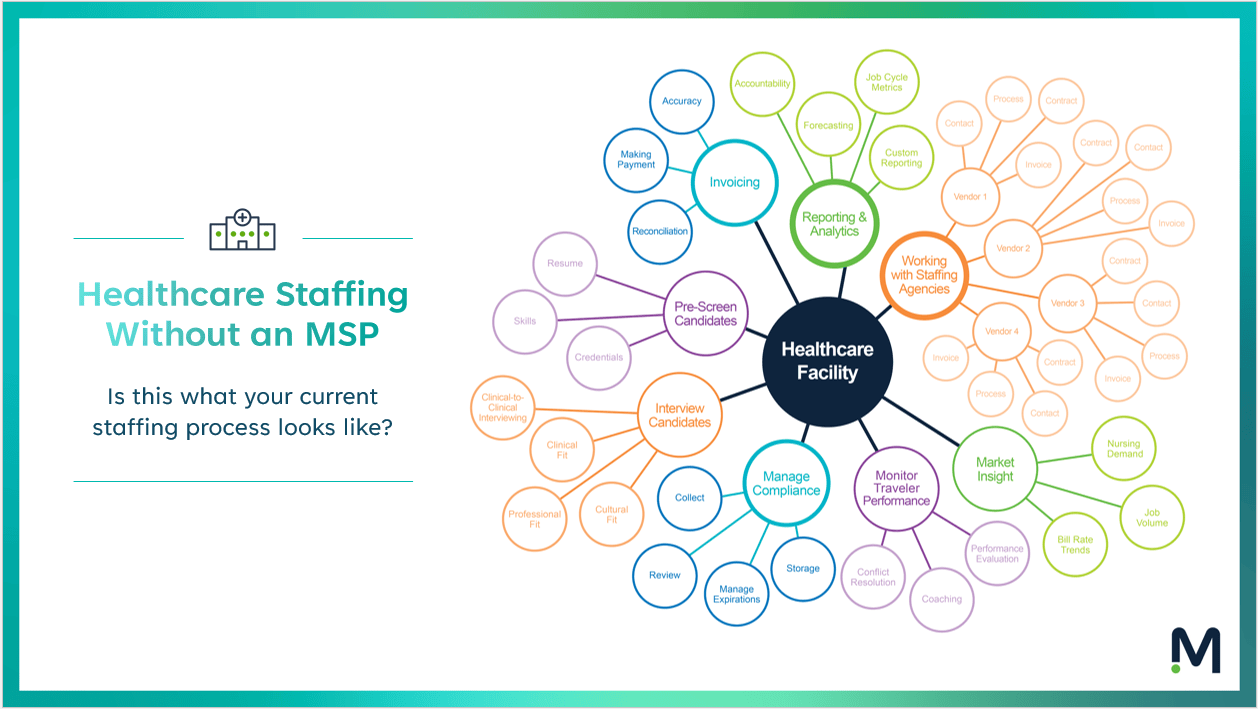
- Administrative Headaches: Managing multiple direct contracts can quickly turn into a full-time job, leading to mountains of paperwork and room for potential errors.
- Compliance Chaos: Each vendor may have different compliance standards, making it difficult to stay on top of industry regulations.
- Mounting Costs: Without centralized negotiation and consistent rate governance, costs can easily get out of hand, eating into your budget.
- Disparate Reporting: Handling key performance indicators (KPIs) and financial reporting from multiple agencies can lead to inconsistent data and a significant internal lift to consolidate all the information. This fragmented approach complicates performance tracking and financial oversight, making it challenging to get a clear, unified picture of your staffing effectiveness and spend.
What Is A Managed Services Provider (MSP) In Healthcare Staffing?
An MSP is a third party that takes primary responsibility for managing an organization’s contingent workforce program. Typical responsibilities include program management, reporting and tracking, supplier selection and management, order distribution, and often consolidated billing.
In practical terms, an MSP centralizes processes that often get scattered across multiple departments with direct contracts, such as vendor coordination, credentialing workflows, compliance checkpoints, performance metrics, and spend visibility. Many programs also include technology enablement (often via a vendor management system) to standardize requests, approvals, timekeeping, and reporting.
A good managed services provider should feel like an extension of your team, not an outside entity that adds layers. It should adapt to how your organization works, then help you make it smoother.

When Should You Switch from Direct Contracts to an MSP?
Timing matters. If you start to encounter any of these signs, it may be time to consider a managed services provider.
Here are 4 indicators to watch for:
- Are staffing costs and complexity rising faster than your current model can handle? Increasing volume, role specialization, and fluctuating demand can overwhelm a model built on direct contracts. An MSP can help manage growth with clearer governance, standardized workflows, and better visibility into where spend is increasing.
- Has vendor management become a daily fire drill? If coordinating across multiple vendors is causing delays, inconsistent coverage, or constant follow-ups, the process may be costing more time than it saves. An MSP consolidates vendor management for smoother operations.
- Is compliance getting harder to track and prove? Credentialing, licensure verification, onboarding, and documentation requirements can be difficult to standardize across many suppliers. Hospitals also operate within broader regulatory frameworks, including Medicare and Medicaid participation requirements. A well-run MSP program can help create consistent compliance processes and audit-ready reporting.
- Is administrative overload pulling leaders away from patient care priorities? If managing direct contracts is consuming too much of your team’s time and resources, an MSP can alleviate this burden, allowing you to focus on patient care, retention, and strategic workforce planning.
What Are the Benefits of Having an MSP?
A strong managed services provider program can make staffing simpler to run and easier to measure. Instead of juggling vendors, spreadsheets, and one-off processes, you get a more consistent way to manage contingent labor across the organization.
Here are some of the biggest benefits healthcare leaders tend to notice:
- Access to Top Talent: MSPs offer a larger and more diverse pool of healthcare professionals, ensuring you always have the best talent available.
- Cost Savings & Spend Control: With centralized rate oversight and vendor governance, it becomes easier to reduce surprises and get a handle on total spend.
- Centralized Management: An MSP brings vendor management, compliance tracking, credentialing coordination, and admin work into one place, so your team is not chasing details across multiple vendors.
- Enhanced Efficiency for Leaders & Managers: When staffing logistics are not eating up a unit manager’s day, they can focus more on patient care and the team in front of them.
- Stronger Compliance Support: MSPs help standardize processes and create cleaner documentation for audits and oversight.
- Data-Driven Insights & Reporting: Instead of assembling reports from multiple agencies, MSPs offer consolidated reporting and analytics so leaders can make decisions with more confidence.
Real-Life Success Stories
CASE STUDY: WVU Medicine Streamlines Compliance Management
Medical Solutions partnered with WVU Medicine to streamline compliance management, improving on-time clinician start rates from 75-85% to over 92% by creating the Client Success Credentialing Specialist role.
CASE STUDY: Relieving Administrative Burden Through Efficient Best Practices
Medical Solutions’ managed services program helped a Level III Trauma Center in Manchester, NH, streamline their staffing processes, reduce administrative burdens, and improve compliance, resulting in cost savings and enhanced patient care during the COVID-19 pandemic.
CASE STUDY: The Power of an MSP
FocusOne Solutions, part of the Medical Solutions healthcare talent ecosystem, partnered with a large Pennsylvania hospital to urgently hire 37 contract RNs, successfully opening a new unit on time and later filling an additional 60 positions.
How to Decide If You Need an MSP Now
If you are trying to decide whether to stay with direct contracts or move to a managed services provider, here is a practical way to pressure-test the decision:
- Look at the real workload: How many vendors are you managing, and how much time is staff spending coordinating, tracking, and fixing issues?
- Identify where compliance breaks down: Where do delays happen? Where does documentation get messy or inconsistent?
- Check your visibility: How long does it take to get a clean view of spend, fill rates, and vendor performance? Do leaders trust what they see?
- Ask MSP-specific questions early: How does rollout work, what technology is included, what does escalation look like, and how will exceptions be handled by unit?
When direct contracts stop scaling, an MSP can be the step that helps your team regain time, improve consistency, and make staffing easier to manage day to day, while still supporting bigger strategic goals through a trusted healthcare workforce solutions partner.